Customs can be understood as habits or standards in daily life and are passed down through many generations. Vietnam has 54 ethnic groups living together, so Vietnamese customs are also diverse.
It is even more proud that some customs imbued with the nation's cultural identity have been recognized and honored by the world many times. In the article below, we will learn about some of the nation's unique customs and practices to preserve, pass on and develop this sacred gift of our ancestors!

How are the unique cultural features of each nation expressed in each custom? @vntrip
1. Betel chewing custom - Communication
Since ancient times, Vietnamese people have had a saying that "a piece of betel is the beginning of a conversation", so a piece of betel goes hand in hand with greetings. Not only is it "the beginning of a conversation", but betel is also a symbol of respect, popular in ancestral worship ceremonies, weddings, longevity ceremonies, etc. In particular, betel is very familiar to everyone, rich or poor, and can be found in any region.

The beauty in the typical communication culture of Vietnamese people @internet
The custom of chewing betel is one of the Vietnamese customs and practices that represents the unique cultural features in communication between people, which were summarized and built by our ancestors. Therefore, betel has a great significance, reflecting the unique lifestyle of Vietnam.
2. Lunar New Year - Holidays
Lunar New Year is the biggest festival of the year in Vietnam. Since the founding of the country, Lunar New Year has contained humanistic values that represent the connection between humans and nature. According to ancient beliefs, Lunar New Year is the beginning of a new farming cycle, a time for descendants to remember and show gratitude to their ancestors and to bond with neighbors,...

The biggest Tet of the year for Vietnamese people is characterized by the culture of "remembering the source of drinking water" and a new beginning @reds.vn
3. New Year's Eve Offerings - Holidays
New Year's Eve is considered the moment when Heaven and Earth are in harmony, when all things come to life with new vitality. Every nation considers New Year's Eve the most sacred moment and has its own way of expressing it. For the Vietnamese people, New Year's Eve is a custom that demonstrates the culture of "remembering the source of water when drinking", showing gratitude to the guardian spirit who looks after the house and asking for a good new beginning.
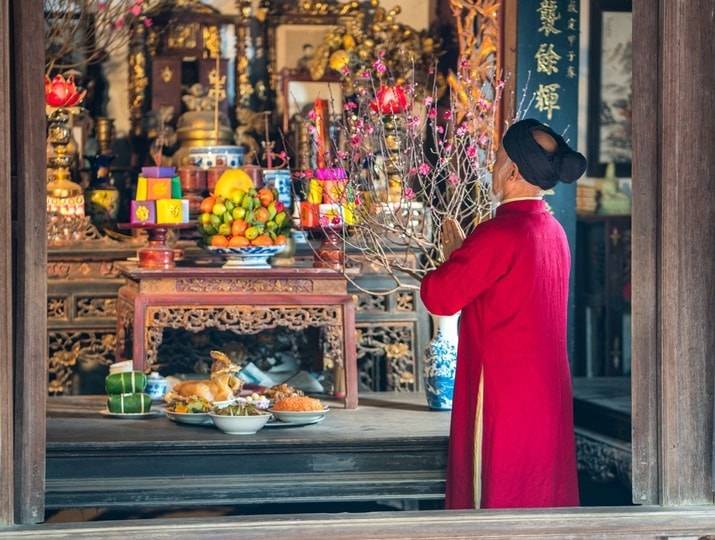
New Year's Eve worship is a sacred moment for all people @internet
The typical New Year's Eve worship custom of our people is to worship from about 23:10 to 0:40, from worshiping outdoors to worshiping the God of the Land to worshiping indoors to welcome the ancestors back to enjoy with their children and grandchildren. The New Year's Eve worship ceremony is one of the Vietnamese customs that everyone knows and respects.
4. Qingming Festival - Holidays
Thanh Minh Festival was mentioned by Nguyen Du in The Tale of Kieu:
Qingming Festival in March
The ceremony is to visit graves and the festival is to go out for a walk.
Through that, we can see that the custom of visiting graves during the Thanh Minh festival of the Vietnamese people has existed for a long time and has great significance. Thanh Minh is considered the fifth of the "twenty-four solar terms", from about April 4 to April 21 (solar calendar) is the time when "the air is clear, the sky is bright".

Each region will have a different way of celebrating Thanh Minh festival @internet
On Qingming Festival, descendants will gather to repair, renew and make offerings at the graves of their ancestors, called "sao mo". This is also an occasion for descendants to reunite with their families. Although not a big festival, Qingming Festival is one of the Vietnamese customs and practices that express the culture of gratitude to one's roots and family affection.
5. Mid-Autumn Festival - Holidays
No one knows when the Mid-Autumn Festival custom was formed, but over thousands of years, the Moon has also been a sacred symbol for the Vietnamese people. The shape of the full or crescent moon is associated with joy, sadness, reunion, and farewell. Therefore, the full moon is a symbol of reunion and the Mid-Autumn Festival is called the Reunion Festival.

Mid-Autumn Festival has unconsciously entered into the consciousness of every Vietnamese person about family reunion @internet
The meaning of the Mid-Autumn Festival customs for Vietnamese people is reunion. On this happy day, everyone in the family gathers together to eat moon cakes, drink tea, chat, and make offerings to their ancestors. And the Mid-Autumn Festival is also known as the Children's Festival.
6. Muong village peace praying festival - Festival
The Muong village peace-praying festival is one of the most important traditional festivals of the Thai and Muong ethnic groups in the Northwestern highland provinces. Among Vietnamese customs and practices, the Muong village peace-praying festival is an activity imbued with the cultural beliefs of the people.

Muong village's peace-praying festival is imbued with folk culture and beliefs @vanhoa
The festival is usually held on the same occasion as the Lunar New Year (late January, early February of the lunar calendar every year). The customs during the festival include: the custom of killing buffaloes to sacrifice and thank the gods through the image of water gods, dragons... And activities that reflect the material, spiritual, mental life, health and crops of the people.
7. Hung Temple Festival - Festival
Hung Temple Festival - Phu Tho is affectionately called by the people as Hung Kings' Commemoration Day. With its national character, this is an important holiday of the country with the meaning of expressing the gratitude and remembrance of descendants for the great merit of building the country of the Hung Kings.

Hung Temple Festival is a Vietnamese custom and also an intangible cultural heritage of humanity @internet
With its outstanding cultural value and widespread influence, the Hung Temple Festival is one of the Vietnamese customs that has transcended the national level and become an intangible cultural heritage of all mankind. On the 8th - 11th of the third lunar month, thousands of people from all over Vietnam and internationally come to worship.
8. Giong Temple Festival - Festival
The Gióng Festival is a traditional festival to commemorate and praise the exploits of Saint Gióng - a legendary hero, one of the four immortals of Vietnamese folk beliefs. The Gióng Festival begins on the 6th day of the first lunar month every year and is held in Sóc Sơn, Hà Nội - the last stop before Saint Gióng ascended to heaven.

Customs of the Gióng Temple Festival in Sóc Sơn - where Saint Gióng took off his armor and flew to heaven @internet
The unique cultural features in the customs and practices of the Gióng festival are religious activities that have been preserved and passed down intact through many generations. The festival is also an occasion for people to offer offerings prepared with respect, praying for Saint Gióng to bless them with a prosperous and happy life.
The Gióng Temple Festival takes place over 3 days with traditional rituals and activities such as: the opening ceremony, the procession, the incense offering ceremony, the bamboo flower offering ceremony, etc. With special cultural values, the Gióng Temple Festival, part of Vietnamese customs and practices, is an intangible cultural heritage of humanity. You can book a flight to Hanoi to combine a visit to the capital and attend the Gióng Temple Festival during this time.
9. Cau Ngu Festival in Thua Thien Hue - Central Region Festival
Normally, the Cau Ngu festival is a custom of most coastal provinces and people living by fishing. This article talks about the festival of the people of Thai Duong village, Thua Thien Hue province, to commemorate Truong Quy Cong - the person who taught the poor how to fish and trade in bamboo boats.
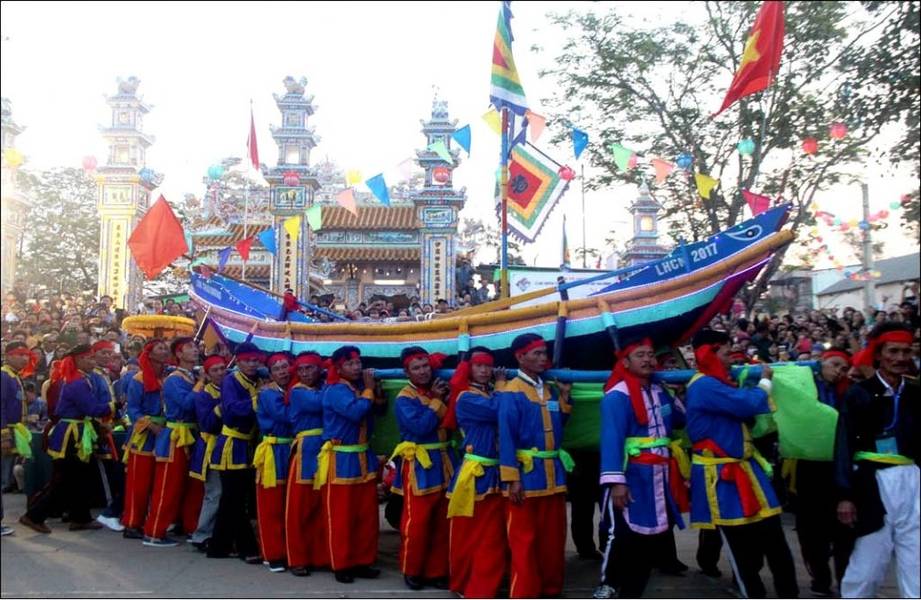
Cau Ngu Festival - Thua Thien Hue is a cultural belief of the people @internet
Cau Ngu Festival in Thua Thien Hue takes place on the 12th day of the first lunar month every year. Therefore, the ideal time to book cheap air tickets to Hue is about 1 to 3 months before departure. During the festival, people will recreate the image of fishing activities, and the village elders will burn incense "pray for peace, pray for fish" to pray for heaven and earth to bless the villagers with good health, to go out to sea to meet calm waves, calm seas, and catch a lot of fish and shrimp.
10. Ba Chua Xu Festival - Southern Festival
The Ba Chua Xu Festival is the largest folk festival in the South, taking place from the night of April 23 to 27 (lunar calendar) every year. This is also one of the Vietnamese customs and practices that have been preserved and passed down through many generations in Chau Doc - An Giang.

The festival of the Lady of the Land is a cultural characteristic of the people of the Southwest @border newspaper
The Lady's festival represents the unique cultural identity of the people of the Southwest and is the cultural continuity of the Kinh community in the process of cultural exchange with the Chinese, Khmer, and Cham people. The annual Lady's festival attracts many visitors to attend and pray for health, fortune,...
The Vietnamese people are fortunate to inherit the unique cultural values that their ancestors left behind. These cultural traits cannot be easily obtained, but thanks to the crystallization through the historical journey, they have become today, becoming prominent Vietnamese customs and practices in the country and the world.
In addition to the customs we have just introduced above, there are many other typical customs of 54 ethnic groups in Vietnam to see how attractive and unique the cultural identity of Vietnam is. We are fortunate to inherit this precious asset, so let's continue to preserve, transmit and promote it together!